Donate


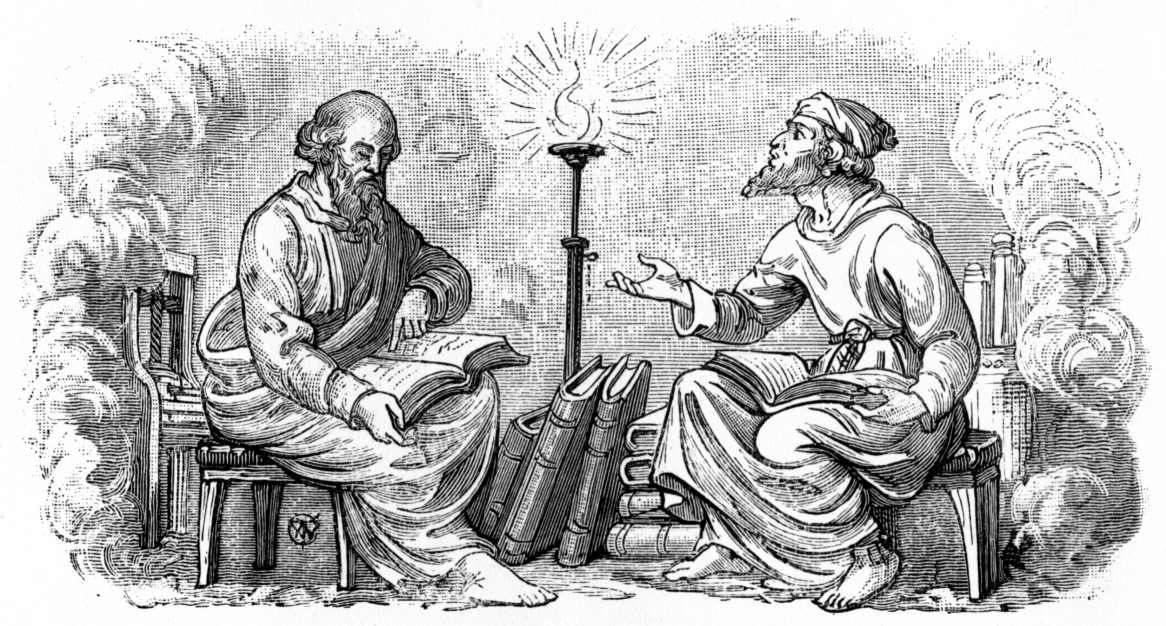 |
| Discourse into the Night, from William Blades' "Pentateuch of Printing with a Chapter on Judges” (1891). [Public Domain] via Wikimedia. |
 Meno by Plato
My rating: 4 of 5 stars
This short dialogue on the issue of virtue (arete) and whether it can be taught is apparently one of Plato's works from his second literary period, written after Book 1 but before the remaining books of The Republic. The introduction to this version is by the translator, Benjamin Jowett.
There are few references to other works in the modern academic tradition, but Jowett makes particular mention of Meno in relation to the works of Descartes, Locke, Bacon, Hume, Spinoza, and Berkeley. I found this interesting as I have been exploring deductive versus inductive methods of research in recent times. Plato tends to be deductive, in moving from general ideas and principles to specifics, whereas the inductive method draws on specific cases to lead to general principles. Karl Popper was not a fan of induction, it seems.
That Plato draws on Pythagoras and Heraclitus is obvious, but Jowett points out that there is no explicitly stated link. Most interesting was Plato's finding (through the words of Socrates, p. 75):
There are few references to other works in the modern academic tradition, but Jowett makes particular mention of Meno in relation to the works of Descartes, Locke, Bacon, Hume, Spinoza, and Berkeley. I found this interesting as I have been exploring deductive versus inductive methods of research in recent times. Plato tends to be deductive, in moving from general ideas and principles to specifics, whereas the inductive method draws on specific cases to lead to general principles. Karl Popper was not a fan of induction, it seems.
That Plato draws on Pythagoras and Heraclitus is obvious, but Jowett points out that there is no explicitly stated link. Most interesting was Plato's finding (through the words of Socrates, p. 75):
Then, Meno, the conclusion is that virtue comes to the virtuous by the gift of God.
That this is an early work makes sense. I frequently adopt the Socratic method in my teaching (as does much of academe even if implicitly) and a few times I have received feedback that sums it up thus:
The Socratic method sucks. I hate it.
By the end of this work, I couldn't help think that Socrates was being egotistical. Sure, he tried to shock people to realise their ignorance, but in this case, and as important as the idea is to so many philosophers, but in particular, Heraclitus, I thought the finding was quite a cop-out. All that posturing to say what Heraclitus had said more eloquently?
The big lesson for me is that the Socratic method, when practised by the un- or under-practised, could easily come off as it does in Meno. I am half-way through a cover-to-cover reading of The Republic at the moment, which seems better polished and far less obtuse. It may well be that Desmond Lee's translation is better than Jowett's. But clearly, if I am to be better at using the Socratic method, I must take into account how an amateurish use of the method may come off as egotistical with my students. I can recall the instances where this may well have been the case.
But the idea of deduction versus induction and Jowett's comments on Plato in relation to other philosophers ranging from Descartes to Spinoza are worthy of further exploration.
Additionally, Jowett states that modern philosophy no longer asks the sort of questions asked by Plato (p. 29). I think this explains why Nietzsche's madman shouts in the market place (The Gay Science, section 125, p. 90):
The big lesson for me is that the Socratic method, when practised by the un- or under-practised, could easily come off as it does in Meno. I am half-way through a cover-to-cover reading of The Republic at the moment, which seems better polished and far less obtuse. It may well be that Desmond Lee's translation is better than Jowett's. But clearly, if I am to be better at using the Socratic method, I must take into account how an amateurish use of the method may come off as egotistical with my students. I can recall the instances where this may well have been the case.
But the idea of deduction versus induction and Jowett's comments on Plato in relation to other philosophers ranging from Descartes to Spinoza are worthy of further exploration.
Additionally, Jowett states that modern philosophy no longer asks the sort of questions asked by Plato (p. 29). I think this explains why Nietzsche's madman shouts in the market place (The Gay Science, section 125, p. 90):
God is dead! ... And we have killed him!
Here Plato has Socrates tell us that virtue is a gift of God, which I can see means that to be virtuous requires one to find God. Rather than the shopkeepers telling Nietzsche's madman that they didn't know we had lost Him, and in spite of Plato's unrefined use of the dialogue (compared to his more advanced, later use), it would seem that modern philosophers are the crowd looking on and laughing at Nietzsche's madman (or, if you prefer, Huxley's self-flagellating Savage), while all the time they have forgotten their very origins.
But best not to be egotistical and amateurish.


%20%5BCC0%201.0%5D.jpg)