This is why you should read the classics...

Luigi Silori and Italo Calvino (1958). Photo by Duccio55, CC BY 3.0 via Wikimedia.


Why Read the Classics?Why Read the Classics? by Italo Calvino

My rating: 5 of 5 stars


This is the second book of Calvino's work, and the only of his non-fiction works, that I have read. The first was Marcovaldo, a collection of short stories about an Italian peasant who attempts to "reconcile country habits with urban life". I was aware that Calvino was regarded as something of a philosopher, and the title of this work intrigued me after reading Mortimer Adler's How to Read a Book. What I found interesting about Why Read the Classics?, which is effectively a collection of book reviews, is that Calvino covers from Homer to the present, adding a touch of personal insight into each review, and a depth that is still beyond my reading of the Great Books. Calvino does what I have been doing for some time now (albeit I do this nowhere near as well). I suspect that the individual essays in this collection were written as Calvino read or re-read these classic authors and their books. The first essay, which provides the title of the book, provides Calvino's list of fourteen definitions of a "classic book". In the introduction, the translator, Martin McLaughlin, uses Calvino's definitions to put forward an all-encompassing definition that I find useful in identifying "classic" works with more than just "old" works:
A classic work is a work which (like each of Calvino's texts) retains a consciousness of its own modernity without ceasing to be aware of other classic works of the past.
Of the thirty-six essays, only eleven of the essays had appeared in English before. This immediately strikes me as fortunate, yet, at the same time, somewhat saddened that there is so much that monolingual readers like myself will never have the opportunity to read. Calvino provides confirmation of Mortimer Adler's view on reading classic works, and justifies my own stance on using my time for a first-hand reading, even though I must admit that a good deal of my learning up until completing my PhD was based on secondary sources (beyond journal articles and historical texts). Calvino suggests that:
Reading a classic must also surprise us, when we compare it to the image we previously had of it. That is why we can never recommend enough a first-hand reading of the text itself, avoiding as far as possible secondary bibliography, commentaries, and other interpretations.
What I also find interesting is that Calvino explains what I feel when re-reading classic works that I may not have understood when I was younger. For example:
When we reread the book in our maturity, we then rediscover these constants which by now form part of our inner mechanisms though we have forgotten where they came from.
This leads me to another of Calvino's definitions which rings true:
A classic is a book which even when we read it for the first time gives the sense of rereading something we have read before.
I have experienced this many times before, however, it was most obvious recently when reading John Stuart Mill and Ruskin. In yet another definition, Calvino explains this further:
A classic does not necessarily teach us something that we did not know already; sometimes we discover in a classic something which we had always known (or had always thought we knew) but did not realise that the classic text had said it first (or that the idea was connected with the text in a particular way). And this discovery is also a very gratifying surprise, as is always the case when we learn the source of an idea, or its connection with the text, or who said it first.
Again, Calvino justifies my own approach. For example, he says that a "person who derives maximum benefit from a reading of the classics is the one who skilfully alternates classic readings with calibrated doses of contemporary material" (p. 8). That is not to say that I consider myself to be particularly wise. Indeed, Calvino tells me that my reason for alternating classics with contemporary materials might be "the result of an impatient, nervy temperament, of someone constantly irritated and dissatisfied". This is probably closer to the truth. In Calvino's essay on the Odyssey he discusses the nature of folktales. In this way he echoes Aristotle's Poetics. For example, he looks at stories of rags to riches or the more complex riches to rags and back to riches again and how these different types of misfortune are enjoyed by all because these represent "the restoration of an ideal order belonging to the past" (p. 13). In some ways, this explains why I like the classics, yet Calvino warns us that:
The contemporary world may be banal and stultifying, but it is always the context in which we have to place ourselves to look either backwards or forwards (p. 8).
So Calvino is not simply a "stuck in the mud", but for me, he places the classics in an appropriate context. While much was familiar in these essays, there was also a good deal of work that was unfamiliar to me. Many of these authors did not produce their works in English, hence my unfortunate lack of knowledge. One such author, Stendhal, introduced me to the interesting idea that "liberty and progress... was suffocated by the Restoration" (p. 136), and that Pliny considered there to be a "tacit accord" reached between peoples about "three cultural facts". These include "the adoption of the (Greek and Roman) alphabet; shaving of men's faces by Barber; and the marking of the hours of the day on a sundial" (pp. 44-5). There are some familiar authors too, including Dickens, Tolstoy, Mark Twain, Henry James, Robert Louis Stevenson, Joseph Conrad, and Ernest Hemingway. And I was pleasantly surprised to see that the behaviourist, B.F. Skinner, makes an appearance (p. 116), albeit briefly. There is little to be gained from going over each of the essays, however, I have kept notes that I can return to in accordance with Mortimer Adler's rules for reading. The concluding essay, Parvese and Human Sacrifice, provides an interesting response to politics that is relevant today:
...as though he were shrugging his shoulders because everything is already clear and is not worth expending any more words (p. 263).
However, it is "The Philosophy of Raymond Queneau", the second last essay, that concludes the work best for me, in that the written word need not be pompous and unwelcoming, where a writer could make the reader:
...feel on the same level as he is, as they were about to play a round of cards with friends... [yet such a writer] is in reality someone with a cultural background that can never be fully explored, the background whose implications and presuppositions, explicit or implicit, one can never exhaust (p. 246).
Calvino wrote many other works, including novels and non-fiction, and although I understand he was a very private person, his letters have recently been published. I think I shall read more of his fiction and non-fiction before I delve further into the his private life. But clearly, there is much to be learnt from reading Calvino.



Kapuściński's Magical Journey: Fact or Fiction?

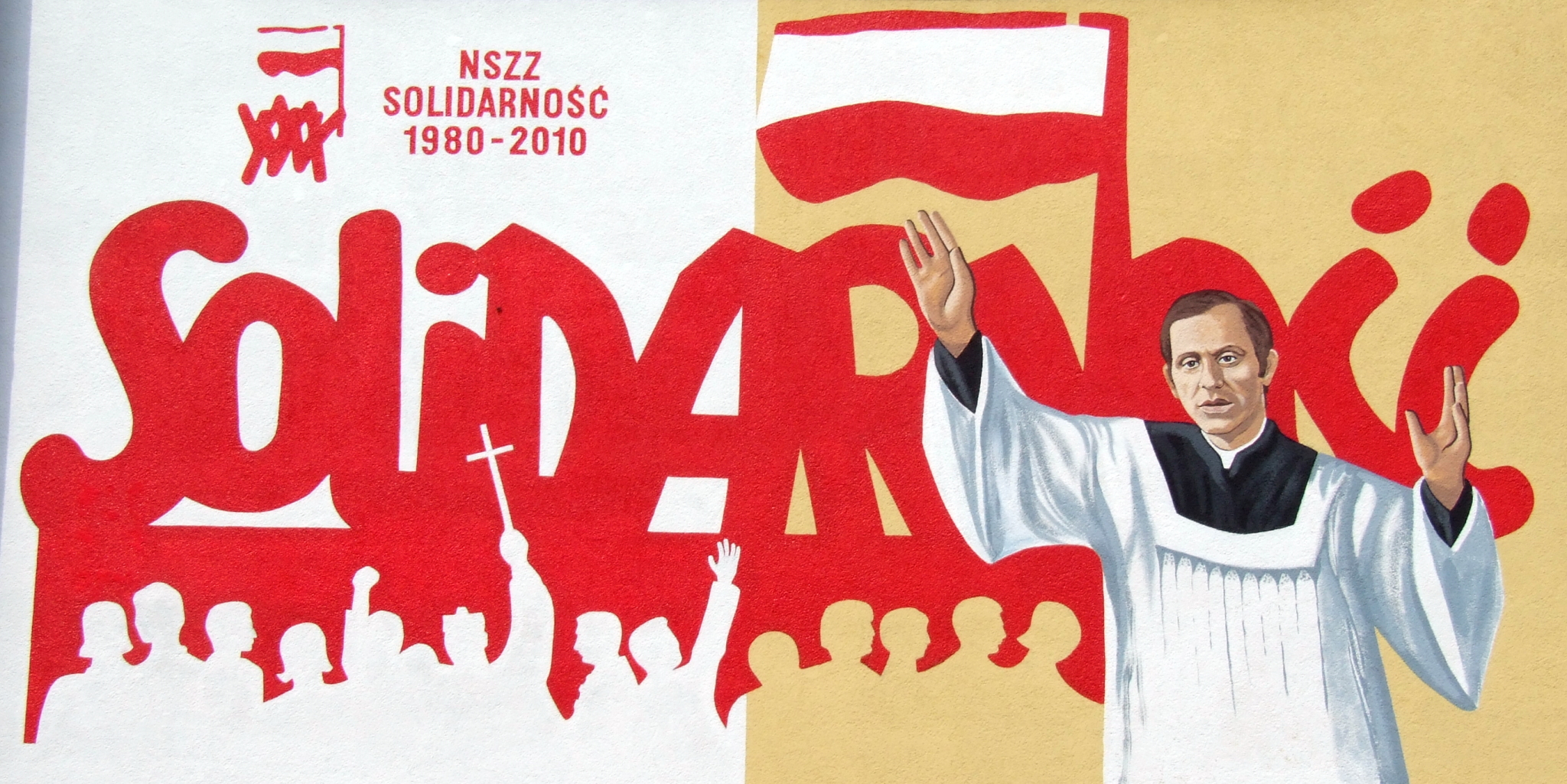
30-years of Solidarity mural in Ostrowiec Swietokrzyski. Photo by Krugerr (2010) CC BY 4.0 via Wikimedia.


An Advertisement for ToothpasteAn Advertisement for Toothpaste by Ryszard Kapuściński

My rating: 4 of 5 stars


Ryszard Kapuściński was born in Belarus and grew up in Poland. He is regarded as one of the greatest journalists of the twentieth century for his coverage of revolutions and coups in places including Africa, the Middle East, and Latin America. In the 1950s, he began working for the Polish Press Agency (PAP), a communist state-run news service. It is interesting that, since Kapuściński's death, he has been criticised for "making up" the news he reported in order to perpetuate his legend. Yet Kapuściński believed that poets were best-placed to be journalists, as they knew both style and brevity, and his works of fiction, including novels and short stories, were enough to put him in the running for the Nobel Prize in Literature. This book of four stories covers the lives of the poor in Poland. The stories include: An Advertisement for Toothpaste, Danka, The Taking of Elżbieta, and The Stiff. In very few words, Kapuściński's short stories bring to life the subtitle of the work these stories are drawn from: Nobody Leaves: Impressions of Poland, which were only translated into English in 2017. To borrow from various other critics, Kapuściński's style is most notably "sympathetic" to the people he writes about. The biography published by Artur Domoslawski after Kapuściński's death provides the most "plausible" critique, not so much of his work, but of his ability to tell a story while being somewhat liberal with the facts. But on reading these four stories, I have an image of life in the poorer parts of Poland. The reader can see the church in the shadow of the commune, one can feel the strange place of Poland as a country of white people who were, in effect, colonised by whiter people, and apparently Kapuściński used this to his advantage when travelling through revolutionary/post-colonial Africa to give him access (and escape) from places no other white person could. To come back to Poland, and the focus of these four short stories, I can picture it in my mind as if it had been painted for me, but written in a minimalist style that provides sufficient structure for me to draw the rest. Not like Hemingway's icebergs, for there is sufficient meat on the literary bones, but in such a short space as to indicate the extent of Kapuściński's genius. I expect to return to Kapuściński's work again soon, and I can only hope his books are nearly as good as these short stories. These, as far as I can tell, are all regarded as "travel writing" (a genre I enjoy). The recent emergence of Kapuściński's "lost" (i.e. untranslated) works in English leaves me wondering how much literary brilliance is left waiting to be discovered throughout the world. It also makes me wonder where we would be without books such as this accessible Penguin series of translated works. Kapuściński was fluent in several languages and witnessed much of the undoing of colonialism and communism. It is little wonder that his work is so good, and one can only imagine how his experience of the world shaped his craft. And rather than be envious, I must admit to feeling pleased that I can experience his travels in the safety and comfort of my own home, for surely such a life was hard work. I like to think that Kapuściński's "magical journalism" comes from the magic he sought through his living, and that some of his magic rubs off on those who are fortunate enough to read his works.


View all my reviews

On Creativity and Liberalism: Albert Camus

Allegory of the Seven Liberal Arts by Maerten de Vos (1590). Public Domain via Wikimedia.

Create DangerouslyCreate Dangerously by Albert Camus

My rating: 4 of 5 stars


This short work consists of three speeches: Create Dangerously, delivered in 1957 a few days after Camus was awarded the Nobel Prize in Literature; Bread and Freedom in 1953; and Defence of Intelligence in 1945. For Camus, there are two kinds of intelligence: "intelligent intelligence, and stupid intelligence" (p. 7). Camus searches for the authentic liberty, rather than the society of signs, the artificial liberty that "inscribes the words 'liberty' and 'equality' on its prisons as well as on its temples of finance" (p. 7). Artists struggle with liberty, in that, to be regarded as great, they must be popular, but in being popular, they cannot be great. Asserting one's freedom is an act of establishing order over chaos:
The free artist is one who, with great effort, creates his own order (p. 27)... [and assumes] all the risks and labours of freedom (p. 28).
Art, then, is the "enemy marked out by every form of oppression" (p. 29). It is here that I start to see parallels between Camus' time (the time of mutually assured destruction) and our own era of incremental tyranny. Camus surprises me by a desire to defend the West, and it would seem specifically the defence of the liberal tradition. But he is not pessimistic; rather, the artist's "ordeal contributes meanwhile to our chances of authenticity" (p. 31). Rather than seeking solitude, the paradox is that the artist must not be popular, but must find peace "in the heat of combat". This reminds me of Jordan B. Peterson and the criticism he is facing at the moment. I must suspend my criticism here as I have only read parts of his work as it relates to Stoicism, but Peterson is surely in the heat of combat in his attempt to make order out of chaos. This connection with the Stoics and Peterson is interesting and appears in Defence of Intelligence, in that:
...the enemy in the future must be fought within ourselves, with an exceptional effort that will turn our appetite for hatred into a desire for justice (p. 36).
And the comparison with our present doesn't end there. For Camus, who fought against the Nazis as part of the French Resistance, attacks against intelligence were part and parcel, not just of Nazi Germany, but of greater Europe:
Goering gave a fair idea of their philosophy by declaring: "When anyone talks to me of intelligence, I take out my revolver". And that philosophy was not limited to Germany. At the same time throughout civilised Europe the excesses of intelligence and the faults of the intellectual were being pointed out" (p. 37).
Now tell me that doesn't resonate with your daily news feed? Artists (experts?) should not "give in when they are told that intelligence is always unwelcome or that it is permissible to lie in order to succeed". Is that what is happening in academia? The collection concludes with Bread and Freedom, where Camus tells us that justice and freedom go hand in hand: we cannot have one without the other, and we cannot allow the few democratic liberties we have now be "taken from us without a protest" (p. 48). If the first concern of any dictatorship is to "subjugate labour and culture", then it is clear we are well-advanced on the path to tyranny. Like all great works of the liberal tradition, Camus' final words ring true:
[F]reedom is not a gift received from a State or a leader but a possession to be won every day by the effort of each and the union of all (p. 54).
And while for years we have focused on the state and society more generally, and for all our "individualism", I cannot help but think that we have lost the idea of liberty. The words of James Allen (As A Man Thinketh, p. 91) (and certainly the Stoics would agree) mirror Camus' view:
Where the calm mind is there is strength and rest, there is love and wisdom; there is one who has fought successfully innumerable battles against self, who, after long toil in secret against his own failings, has triumphed at last.
For Camus, the problem is more complex than just the artist fighting against or capitulating to the state: it is insidious. It is like the screaming echo chambers of social media, where we protest. But we cannot tell whether we are the martyr or the lion (p. 4); the artist is not faithful to her own genius (p. 5). To put it simply, there is no comfort in freedom, and the free artist is no more comfortable than the free man. Camus seems to be telling us that in the life of the artist, and this encompasses all of "the arts", wisdom only declines when it involves no risk and "belongs to a few humanists buried in libraries" (p. 31). Rather than condemn, the artist must absolve (p. 25). If I were to capture the big problem in higher education in a short sentence, it would be students' constant search for the "right" answer. If wisdom and learning is hard won, and there is no right answer, then this becomes a recipe for burn-out, or at least a jaded fatigue. Camus reminds us that this is because we look for good and evil (see also Nietzsche), rather than to understand. And so, to absolve rather than condemn, to take on the risks and the labours of freedom. Were it only so simple.


View all my reviews
© 2025 Dr Michael de Percy
made with by templateszoo