Book Notes: "Poetics" by Aristotle

PoeticsPoetics by Aristotle

My rating: 3 of 5 stars


Every piece has a beginning, a middle, and an end. Sounds so simple. We teach students that every essay has an introduction, a body, and a conclusion. But here it is being written for the first time. Art imitates life. Much of this work sounds cliched, but it is the original!


View all my reviews

Book Notes: "Enchiridion" by Epictetus

EnchiridionEnchiridion by Epictetus

My rating: 5 of 5 stars


Enchiridion reads like the Proverbs and the Hadith. I am finding much in Stoicism that aligns with many of my own ideas. I am not sure whether this is from aspects of training and education that were implicitly Stoic or not. Indeed, I cannot recall any explicitly Stoic teachings in my formal education. Long's translations are interesting and draw upon previous translations. The notes are helpful, especially where all translators are unable to comprehend the precise meaning of certain of Epictetus's [reading Stephen King converted me to the s's rather than the s' plural] "fragments". This is a quick read, and worth further reflection.


View all my reviews

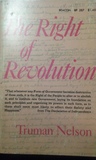
Book Notes: "The Right of Revolution" by Truman Nelson

The Right of RevolutionThe Right of Revolution by Thomas Truman

My rating: 3 of 5 stars


Truman Nelson's work is relatively obscure today, but his belief in the right of revolution burns in the pages of this book. Written following the Newark riots, Nelson challenges the status quo by drawing on the Constitution's 'Right of Revolution' and the Fourteenth Amendment to justify armed action in response to inequality based on race. Reading this was timely, as I will soon read John Locke's Second Treatise on Government which was drawn upon in the framing of the Constitution. Nelson refers back to the American Revolution and the Civil War, arguing that civil rights for African Americans were paid little more than lip-service. The glacial pace of actualised civil rights meant that revolution was the only way to make these rights real. What is interesting is the historical 'process' of civil rights, with one step forward, two steps backward appearing again and again throughout history. When applied to the problems of today, it is clear that we are currently in the 'two steps backwards' phase. Nelson makes the story of republican liberal democracy come to life, and challenges the conservative republicanism that is all-pervasive in present times. That Nelson considered revolution to be the stuff of republican liberal democracy is obvious, but it is now a myth of antiquity, long lost in the fifty-odd years since his writing. This work makes me think that we are entering the final phase of the end of empire.


View all my reviews
© 2025 Dr Michael de Percy
made with by templateszoo