The Humble Sentence

Photo by Holly Chaffin [CC0 Public Domain] via publicdomainpictures.net


How to Write a Sentence: And How to Read OneHow to Write a Sentence: And How to Read One by Stanley Fish

My rating: 3 of 5 stars


My reading year began with Mortimer Adler's How to Read a Book. Adler mentions (p. xi) that after the book became a best-seller, it was parodied by How to Read Two Books and, more seriously, How to Read a Page. So when I saw How to Write a Sentence: And How to Read One, I was intrigued. 

With my usual marginalia noticeably absent, I must say the book was worth reading, but it is relatively easy enough to take in in one go. The book provides numerous examples of great sentences, including great beginning and ending sentences. (Dickens doesn't get a mention other than a suggestion that his were over-rated.) There are a number of exercises using various sentence types that are useful. 

Hemingway thought that if he could write just one good sentence, then the day was well-spent (A Moveable Feast, p. 22):
I would stand and look out over the roofs of Paris and think, 'Do not worry. You have always written before and you will write now. All you have to do is write one true sentence. Write the truest sentence that you know.' So finally I would write one true sentence, and then go on from there. It was easy then because there was always one true sentence that I knew or had seen or had heard someone say.
Fish doesn't go so far, but sees the sentence as a building block for all great writing. I particularly liked the idea that to be a writer, one has to like sentences, much like the painter who paints because she likes the smell of paint (p. 1). And the poem by Kenneth Koch really sums up this delightful little book:
One day the Nouns were clustered in the street.
An Adjective walked by, with her dark beauty
The Nouns were struck, moved, changed.
The next day the Verb drove up, and created the Sentence.
I would say that the major benefit of reading this work is that it brings the sentence back as the unit of work. I tend to focus more on paragraphs as corralled ideas, but overlook the importance of the humble sentence. Having read this work, I hope I can implement some of the clever suggestions and see the role of the humble sentence in framing not just stories, but also my academic work.

I found this book on Maria Popova's Brain Pickings.
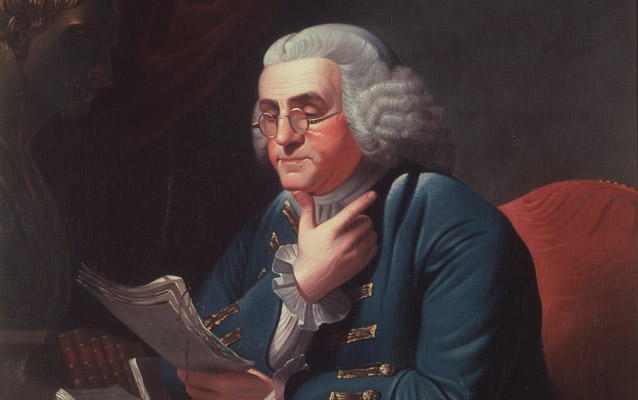


Benjamin Franklin: Unmasked!

Benjamin Franklin by David Rent Etter, after Charles Willson Peale, after David Martin (1835). National Park Service photo [Public Domain].


The Cambridge Companion to Benjamin FranklinThe Cambridge Companion to Benjamin Franklin by Carla Mulford

My rating: 5 of 5 stars


I have taken Mortimer Adler's advice to heart and so I try to read an author's work before delving into "companion" volumes. But there were many questions I had about Benjamin Franklin, in particular his autodidacticism and his thirteen virtues. How did this happen? What resources did he draw on in developing this process? What did he mean by "Moderation"? This volume, edited by Carla Mulford, answered many of my questions in the first two chapters: "Benjamin Franklin's Library" and "The Art of Virtue". Funnily enough, the first thing I noticed is that Franklin had a habit that was mirrored by Adler (p. 15):
Marginalia provide a way to make a book more practical as well as more personal.
Franklin also found the need to organise his books, although his personalised system was much more pragmatic than mine (p. 18). I discovered, too, ideas about Franklin's pedagogy. For instance (p. 53):
The lecture, the sermon, and all forms of face-to-face hierarchical instruction seemed to Franklin to avoid enlisting people in the creation of mutual understanding and of new forms of knowledge. Such one-sided articulations forced people to accept established truisms, unexamined claims that served and preserved the old order.
Further (p. 54):
His memoirs document his abandonment of methods of forceful assertion and concerted argument in favour of an equivocal, Socratic method.
Franklin saw "enlightened reason" as what we would call today a "democratic" faculty (p. 78), and he believed that (p. 79):
...all received knowledge could and must be tested empirically.
Franklin's views on religion are interesting, if not pragmatic. He advocated for Congress to begin with opening prayers (p. 100) (this still happens in the Australian Parliament) and saw religion as a way of keeping "the ignorant masses from sloth and insurrection" (p. 83). In terms of virtues, Franklin looked not only at individual virtues, but those in relation to "social customs through an evaluation of their results" (p. 108). One point that clarified the dilemma I had noticed but could not articulate (p. 142):
Franklin... simultaneously preached the doctrines of self-denial and good living.
There is so much more in this small volume but best of all it is an academic work. Which means my marginalia focuses almost exclusively on the detailed notes and references provided to each of the essays. I wouldn't recommend reading this before at least reading Franklin's autobiography, but as a companion to the Great Man, this volume is excellent.


Idealism's fine, but actions speak louder than words...

Eleanor Roosevelt and Fala at Val,Kill in Hyde Park, New York. Photo taken by FDR, November 1951 [Public Domain] via Wikimedia.


Tomorrow is NowTomorrow is Now by Eleanor Roosevelt

My rating: 3 of 5 stars


I am involved in a research project focusing on the four pillars of women, peace and security, emanating from the United Nations' Security Council (UNSCR) Resolution 1325. So I have been doing a number of courses by UN Women and learning about the UN's "gender mainstreaming" project. The basic premise is that gender matters in how people experience their rights, and from here, I decided to read some of Eleanor Roosevelt's work because she was instrumental in the United Nations Universal Declaration of Human Rights. Without Roosevelt, the document that has become so important as a guiding principle for much of the UN's work may not have come to fruition.

There are many critiques of the universality of the declaration, because it starts with a liberal premise, as in the individual is key. I have Roosevelt's autobiography to read at a later stage, but this work intrigued me as it has an introduction by Bill Clinton, and Roosevelt (effectively) stayed alive to finish the book, and died soon after it was completed. (The book was published a few months after her death.) There is much that will make the "Yay, Democracy" crowd happy, and it is clear that the examined life is her idea of the right life:
Self-government requires self-examination, action by the individual, standards, values, and the strength to live up to them.
This is not too far from Mortimer Adler's idea of The Great Conversation. Roosevelt was sceptical of science, and no doubt would have disapproved of the "I f*#king love science" crowd, channelling Huxley and Orwell (p. 123):
...each provided us with an appalling picture of the future of mankind, a life dominated by scientific method in which the humanities and the human spirit had been destroyed... [rather than] use science as an enlightened tool to make this world closer to a Utopia than man has ever dreamed.
Nothing for me to disagree with here, but I attended a number of research presentations lately looking at post-colonial African politics, and the findings were disturbing. So much of the liberal tradition does not readily apply to the rest of the world. I recall Theodore Roosevelt's Autobiography (he was Eleanor's uncle) where the politics of the United States were so corrupt at the beginning of the 20th century, more than 100 years after democracy had been instituted. How are poor, post-colonial countries meant to transition to democracy (which assumes that in itself is a good thing) in a few years when it took the world superpower over a century? These are the questions that concerned me as I read Roosevelt's ideal future. But it certainly fits with my own liberal ideals, for example (p. 124):
I have emphasised in this book two areas in which we must begin preparation today: education and the essential need of sparking in a new, deep, and fervent sense of responsibility in every individual.
Yet I immediately think of Margaret Thatcher and the extreme ends of individualism - all extremes lead to the same rot. That is not to say that Roosevelt's work isn't important, or that it isn't timeless. But is is certainly worth questioning from a non-liberal perspective. The ideas of the United States are seen as a panacea for the ills of the world, and I just can't see how that idealism means much today.

In her life she achieved so many things and many of these were of benefit to those who needed it most. She saw the benefits of education and travel, and was impressed by her grandson's education in the Peace Corps - he learnt that systems of manners are as important as fast access to clean drinking water, and that honouring one's culture enables collective action, so she was certainly not an individualist in the modern sense. Rather than find value in this work as a program for the world, I found value in the program for the self, or, to quote James Allen (1921, p. 48)
...he who has conquered self has conquered the universe.
For Seneca Daily Stoic, p. 241):
Many words have been spoken by Plato, Zeno, Chrysippus, Posidonius, and by a whole host of equally excellent Stoics. I'll tell you how people can prove their words to be their own - by putting into practice what they've been preaching.
Eleanor Roosevelt personifies this idea: actions speak louder than words.


View all my reviews
© 2025 Dr Michael de Percy
made with by templateszoo