Reflecting on Reflecting in 2017: My year of The Daily Stoic

The Fog Warning/Halibut Fishing by Winslow Homer (1885).
Public Domain via Wikimedia.


The Daily Stoic: 366 Meditations for Clarity, Effectiveness, and SerenityThe Daily Stoic: 366 Meditations for Clarity, Effectiveness, and Serenity by Ryan Holiday

My rating: 5 of 5 stars


I used The Daily Stoic to trigger my daily journalling, along with James Allen's As a Man Thinketh and La Rochefoucauld's Maxims, for all of 2017. The book is well-presented in hardcover with a ribbon bookmark, which makes it easy to use every day and rugged enough to withstand the rigours of travel (if not a little bulky). I have purchased The Daily Stoic Journal for 2018, but think I might use The Daily Stoic again. Journalling is key to Stoic practice, and the practice must be daily if the logic is to stick. I find if I miss a day when travelling (and even if I catch up later), it is easy for old habits to return and thwart one's peace. I used James Allen's work for my morning and evening reflection, and, in the first half of the year, I went through two cycles of Benjamin Franklin's Thirteen Virtues. I intend to go back to Franklin's program recommencing tomorrow, and maintain this for as long as I can. The chief problem is to avoid over-burdening my journalling, and sticking to the words of others. It is a habit I hope to break and I am reading other famous journallers (such as Sir Walter Scott) to see how they journalled (in addition, of course, to Aurelius' Meditations). There is always the risk that we will lose our own voice (which The Daily Stoic points out on 22nd December, using Ralph Waldo Emerson and Seneca to encourage one to "Stake Your Own Claim"). This book is now part of my Stoic toolkit. As much as I would like to be self-motivated, this book is a useful prompt to get one thinking and reflecting. The last twelve months have been a godsend, and Stoic practice - the practice is the important part - has helped me keep my calm (to the point where I reflect on my previous self as if he were a neurotic stranger). I am looking forward to using The Daily Stoic Journal this year. I must admit that subscribing to Ryan Holiday's Reading List some three years ago was one of the best things I ever did. I discovered the reading list via The Art of Manliness, and I haven't looked back since.


View all my reviews


Here's why sodium lauryl sulfate is in most of your cleaning products (including toothpaste)

Watercolour by John Orlando Parry, "A London Street Scene" 1835. Public Domain via Wikimedia.


The Power of Habit: Why We Do What We Do and How to ChangeThe Power of Habit: Why We Do What We Do and How to Change by Charles Duhigg

My rating: 3 of 5 stars


This is an interesting work in that it helps to distil a good deal of scientific research into a practical and interesting guidebook. Habits are effortless ways to live, some good, some bad. But what is clear from the research is that habits consist of three elements:
  1. The Cue.
  2. The Routine.
  3. The Reward.
Extrapolating from this process, the way to change one's habits is as follows:
  1. Identify the routine.
  2. Experiment with rewards.
  3. Isolate the cue.
  4. Have a plan.
Duhigg not only looks at individuals, but discusses organisational habits. I would call these institutions (rules, routines, procedures), but Duhigg looks into various organisations such as Alcoholics Anonymous, and then broadens this to includes how Target uses statistical data to "target" advertising to customers. The discussion on Pepsodent toothpaste ans how the tingly feeling now associated with brushing one's teeth was a way to create a habit, to the point where if we do not experience the tingle from the toothpaste, we would consider our teeth not clean. What is equally interesting is the notion of suds forming when using cleaning products (including toothpaste). Some time back, we looked for soap alternatives that did not contain the foaming agent sodium lauryl ether sulfate (SLS). (I recall too how we learnt that not all vinegar products are created equal - if you use vinegar to clean your house in an environmentally-friendly manner, ensure you are using brewed vinegar, not the cheaper varieties which I understand are made from a petrochemical by-product.) Put simply, SLS is in almost every product we use because we have become habituated to the nation that cleaning products are not workings unless they foam up (yes, including your toothpaste). Duhigg doesn't mention this chemical but it now makes sense why so many products include this unnecessary chemical - it is to create habits that sell products. While this is quite depressing, Duhigg also mentions the social habits that kicked in during the Montgomery bus boycott in the 1960s, and Dr Martin Luther King Jr.'s use of such social habits to create a social movement. The book concludes with a discussion of free will, and in an appendix, Duhigg provides his procedure for changing his own habits. I find this work useful in combination with many others I have read, such as Change Anything, and almost any of the motivational work by Steven Pressfield. Putting the science behind the process makes for a more nuanced understanding of why we do the things we do. While at times I felt the work was overtly middle-class and mono-cultural, reading at times like a work written before the social decline in the US recognised in Robert Putnam's Bowling Alone, this shouldn't take away from the usefulness of recognising the processes of habits, and the ways to analyse these habits with an aim to changing oneself. As James Allen (1926) may have put it, it is only through self-examination and self-analysis that we can achieve self-purification. Duhigg provides a useful way to actualise such examination and analysis, and a starting point for action.

Depoliticising the English Language, One App at a Time

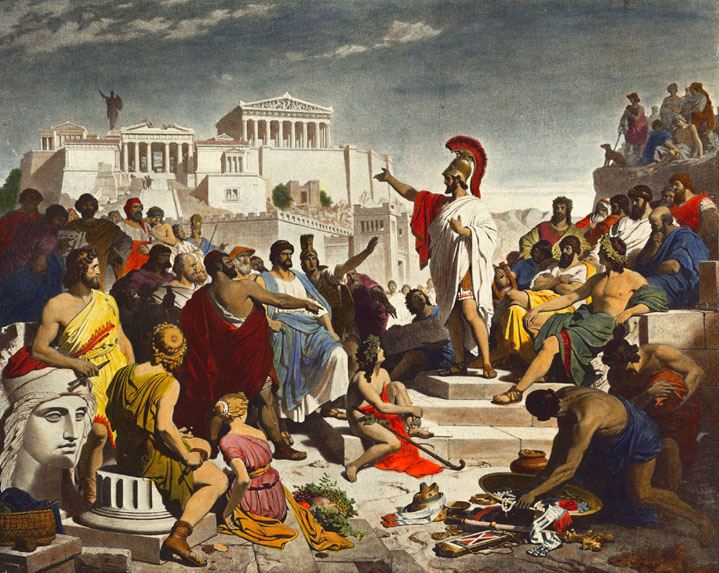
 Discurso Funebre Pericles (Pericles' Funeral Oration) by Philipp Foltz (1877) Public Domain via Wikimedia


Politics and the English LanguagePolitics and the English Language by George Orwell

My rating: 4 of 5 stars


To say that this book is equally applicable today is naive. Orwell's work is applicable to all of history, whether in the sense that politicians rarely say what they mean, or hide atrocities through vague language, or whether all of history has been re-written in such a way as to hide the truth. The word "democracy" as we use it today, and especially when we mean the phrase "liberal democracy", is the opposite of what Orwell writes. For example, why use a phrase when a single word will do? In the case of liberal democracy, why use a single word when we really mean a phrase? Any undergraduate student of politics should know that "liberal democracy" is an "essentially contested concept". But why is this so? Orwell explains:
In the case of a word like democracy, not only is there no agreed definition, but the attempt to make one is resisted from all sides. It is almost universally felt that when we call a country democratic we are praising it: consequently the defenders of every kind of régime claim that it is a democracy, and fear that they might have to stop using the word if it were tied down to one meaning. Words of this kind are often used in a consciously dishonest way. That is, the person who uses them has his own private definition, but allows his hearer to think he means something quite different.
What does this mean? It means that attempting to "depoliticise" (Orwell criticises the use of un- and de- and -ise words) language is a political act. Indeed, to be conservative is to prevent another's exercise of power by exercising a legacy power while claiming that no such power exists. It is interesting that this work includes Orwell's review of Hitler's Mein Kampf, where he claims that in Hitler's Brownshirt days, he was regarded by both the left and the right as a conservative. And whenever I think of Hitler I cannot help but think of the movie Tea with Mussolini, for the same reason. To conclude, this work is relevant to all time, just as the political dramas unfolding today have been unfolding forever, and will continue to do so. But what can we do? If my other reading is anything to go by, we can take a "bird's-eye view" like the Stoics, and see history for what it is. Or, one might adopt an Epicurean approach and withdraw from politics altogether. Nonetheless, if one combines the two approaches, one can see it for what it is, and withdraw, knowing it will make no difference either way, and then focus on using plain and simple English to convey the truth. The major difference today, however, is that there is an app that will help one do just that. Aren't we lucky.


© 2025 Dr Michael de Percy
made with by templateszoo