The Joy of Korean Literature

Photo by CharlieOnTravel at Flicker [CC-BY 2.0] via Wikimedia Commons


The VegetarianThe Vegetarian by Han Kang

My rating: 4 of 5 stars


I have been reading a few novels translated into English lately and I have not been disappointed. I discovered The Vegetarian on the podcast The Joy of Serious Literature last year and finally purchased a copy. 

According to two of my Korean friends, Han Kang's work is quite popular. This book won the 2016 Man Booker International Prize which is awarded to the best novel translated into English. 

Although not a perfect measure, I am yet to be disappointed by a book that has received a national or international award. Kang's prose is brilliant, and her dialogue (a difficult skill to master) is even better. 

What I have noticed from a few international authors is the interesting use of different voices, for example, switching from first to third-person narration in different parts of the book, and also, in this book, bringing three distinct parts into one compelling story. 

What I enjoyed most about The Vegetarian was the complete absence of a happy ending. It begs the question, who was your favourite character? 

Much like the podcast's host's Korean friend, I found the artist to be my favourite. Not because of what he does, which is a bit out there, but because he is "the only character who gets what he wants". 

I doubt stories like this would work for an Anglo author - I think the tone would make it all a bit "dirty". Without giving too much away, if you are looking for inspiration, this isn't the book for you. But if you enjoy the lasting residue of stories well told, this one will stay with you for some time.


View all my reviews

Road Pricing and Provision: Book Published Today

CC By-NC-ND 4.0 [ANU Press]


Today my ANZSOG book (edited with Professor John Wanna) was published by ANU Press.

The book can be downloaded for free here: https://press.anu.edu.au/publications/series/australia-and-new-zealand-school-government-anzsog/road-pricing-and-provision.

Abstract

Road pricing is not a new concept—toll roads have existed in Australia since Governor Macquarie established one from Sydney to Parramatta in 1811—and distance-based charging schemes have been trialled and implemented with varying success overseas.

But how would full market reform of roads look in a federation like Australia? In its responses to the 2016 Australian Infrastructure Plan and the 2015 Competition Policy Review, the Australian Government explicitly supported investigating cost-reflective road pricing as a long-term reform option, and has committed to establishing a study chaired by an eminent Australian to look into the potential impacts of road pricing reform on road users. The challenges we face in this space are manifold and complex, and we still have a long road ahead of us. However, with advocacy for reform coming from interest groups as diverse as governments, private transport companies, peak industry bodies, policy think tanks and state motoring clubs, there is now more support than ever before for changing the way we provide for and fund our roads.

This book seeks to advance the road reform agenda by presenting some of the latest thinking on road pricing and provision from a variety of disciplinary approaches—researchers, economists and public sector leaders. It stresses the need for reform to ensure Australians can enjoy the benefits of efficient and sustainable transport infrastructure as our population and major metropolitan cities continue to grow. Traffic congestion is avoidable, but we must act soon. The works presented here all point to the need for change—the expertise and the technology are available, and the various reform options have been mapped out in some detail. It is time for the policy debate to shift to how, rather than if, road reform should progress.


Blixen on Living the Colonial Life

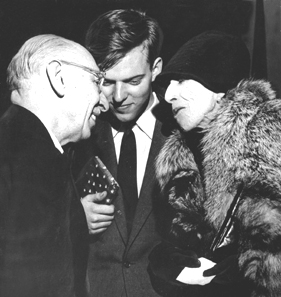
Jurij Moskvitin (middle) acompaning Karen Blixen/Isak Dinesen (right) meeting composer Igor Stravinskij (left) at the City Hall of Copenhagen, 25 May 1959. By Jan Adelfeldt/Scanpix [Copyrighted free use], via Wikimedia Commons.


Out of Africa
Out of Africa by Isak Dinesen

My rating: 3 of 5 stars


I was surprised to discover that the book is nothing at all like the move starring Meryl Streep and Robert Redford. 

Written in English (Blixen was multi-lingual), there is no real hint of the marriage to Baron Bror Fredrik von Blixen-Fineck and their separation in 1920-21 and subsequent divorce in 1925. Nor is there anything more than a subtle hint of the affection for Denys George Finch Hatton (as portrayed by Robert Redford in the movie). 

And who could have known that Blixen suffered from syphilis, courtesy of her philandering husband?

This is an interesting work and reads in part like a diary. Various scholars consider the style and arrangement of the book into certain themes and chronological devices, but this didn't strike me as anything special. It was Blixen's obvious feeling and emotion and love for life in British East Africa (Kenya) that drives the stories. 

One cannot help but be sad when she leaves the farm. One can only imagine, too, what it would be like to live in that timeless place. 

Having said that, the attitude toward the original inhabitants of Kenya reads like any other historically-inspired work of the 1930s, with frequent literary comparisons - as opposed to overtly racist vilification - of some of the characters to monkeys and other animals of the area. Indeed, it is hard to escape the imperialist attitudes of the times and how, given the people had lived on the land for generations, Colonialism suddenly relegates them to the status of squatters (six months of labour in exchange for living on and utilising the uncultivated land of the white farmers). 

There is a much admiration for "the noble savage" that permeates the work, despite Blixen's obvious love for Africa. 

More interesting are the stories of Blixen herself - partly captured in the movie - and that she was nominated for the Nobel Prize for literature several times, losing out to John Steinbeck and Ernest Hemingway. 

Blixen was quite the character, and her other works might be worth investigating. But it is difficult to identify with her in her Colonial context. To be sure, the work captures the place and times, but living in the post-Colonial era, one can only wonder at the past.


View all my reviews


© 2025 Dr Michael de Percy
made with by templateszoo