The Four Seasons of Village Life

Spring

To these modest landholders the rural character of the neighbourhood was a matter of particular jealousy...
(Evelyn Waugh, Put Out More Flags, p. 108).
 
Everyone agreed that the day was just right for the picnic...
(Joan Lindsay, Picnic at Hanging Rock, p. 7).
Sundance draws his Colt, takes careful aim, and fires. He misses.
(Steven Pressfield,The Authentic Swing, p. 55).

Summer

Listen to the pounding old jalopy with all your senses, for a change of tone, a variation of rhythm may mean – a week here?
(John Steinbeck, The Grapes of Wrath).
Time crumbles things; everything grows old under the power of Time and is forgotten through the lapse of Time.
(Aristotle).
The only thing the road cares about is that you pay it a visit once in a while.
(Mel Gibson, What Women Want, 2000).

Autumn

It was a mistake to think of houses, old houses, as being empty. They were filled with memories, with the faded echoes of voices.
(Nora Roberts, Key of Knowledge).
No, of course. It's just the name. There is no fog in London. There is no London fog.
(Lane Pryce, Mad Men).
A tree is known by its fruit; a man by his deeds. A good deed is never lost; he who sows courtesy reaps friendship, and he who plants kindness gathers love.
(Saint Basil).

Winter

I am not afraid of an army of lions led by a sheep; I am afraid of an army of sheep led by a lion.
(Alexander the Great).
No other game combines the wonder of nature with the discipline of sport in such carefully planned ways. A great golf course both frees and challenges a golfer's mind.
(Tom Watson).
Outside of a dog, a book is a man's best friend. Inside of a dog it's too dark to read.
(Groucho Marx).

Spivak: What's in a name?

Michael Bacall as Wally Spivak, in the movie Spivak (2018).

As if to confirm my experience of the inter-relatedness of events across time and space (as depicted in Nowhere Man), I recently watched Michael Bacall's latest movie, Spivak. If Bacall can continue in this vein, he is bound to be the next Woody Allen.

Although there appear to be no reviews from critics just yet, IMDb reviewers of Spivak are divided. I thought it was rather charming, and for a movie about a writer trying to write, it is somewhat inspiring.

Not so much the unlikely situations Wally Spivak (played by Michael Bacall) finds himself in, but that people can and do write novels, and they can and do give book readings and signings in Los Angeles, and the grind of it all looks no different than it would if one were doing the same thing at the Paperchain Bookstore in Manuka, Canberra.

But what is the connection between this movie and Nowhere Man

"Spivak" is a family name of Ukrainian-language origin, and it means "singer". There is more to this name than at first appears. Many Ashkenazic Jews in Eastern Europe, for example. did not have last names until in some cases the early 19th century. "Singer" and its variants was one of the common names adopted.

Interestingly, the family name "Singer" is one that most Anglophones will immediately recognise as the name of the popular sewing machines. But whether Isaac Merritt Singer was Jewish appears to be a hotly debated topic. Apparently, his father was a German-Jew, but Isaac's mother had Isaac christened as a Lutheran. The name was not adopted from "singer" as in a choir, but from the German/Bavarian name "Reisinger".

Nonetheless, the family name "Singer" is a common Jewish family name, for example Yiddish author and Nobel Laureate Isaac Bashevis Singer.

Many families, during Alexander III's policy of "Russification" of the empire's national minorities, including Jews and Muslims, adopted Slavic name endings

As a consequence, Muslims in countries such as Uzbekistan might have the Slavic suffix -ov added to what would otherwise be a Turkic or Arabic name. Further, members of the Mongol's Golden Horde did not use surnames, later adopting surnames which were Slavicized by adding the various Slavic suffixes to Mongolian names.

The question of adapting names to suit host countries continues to this day. In Nowhere Man, we never learn whether Jozef Pronek is Muslim, and he avoids the question each time he is asked.

Similarly, in Spivak, we do not learn about Wally's background. But I found the title of the film intriguing, and there is clearly more to Slavicized names in the former Soviet Union than I ever imagined.


Aleksandar Hemon: On the smell of socialist grease and vinegar

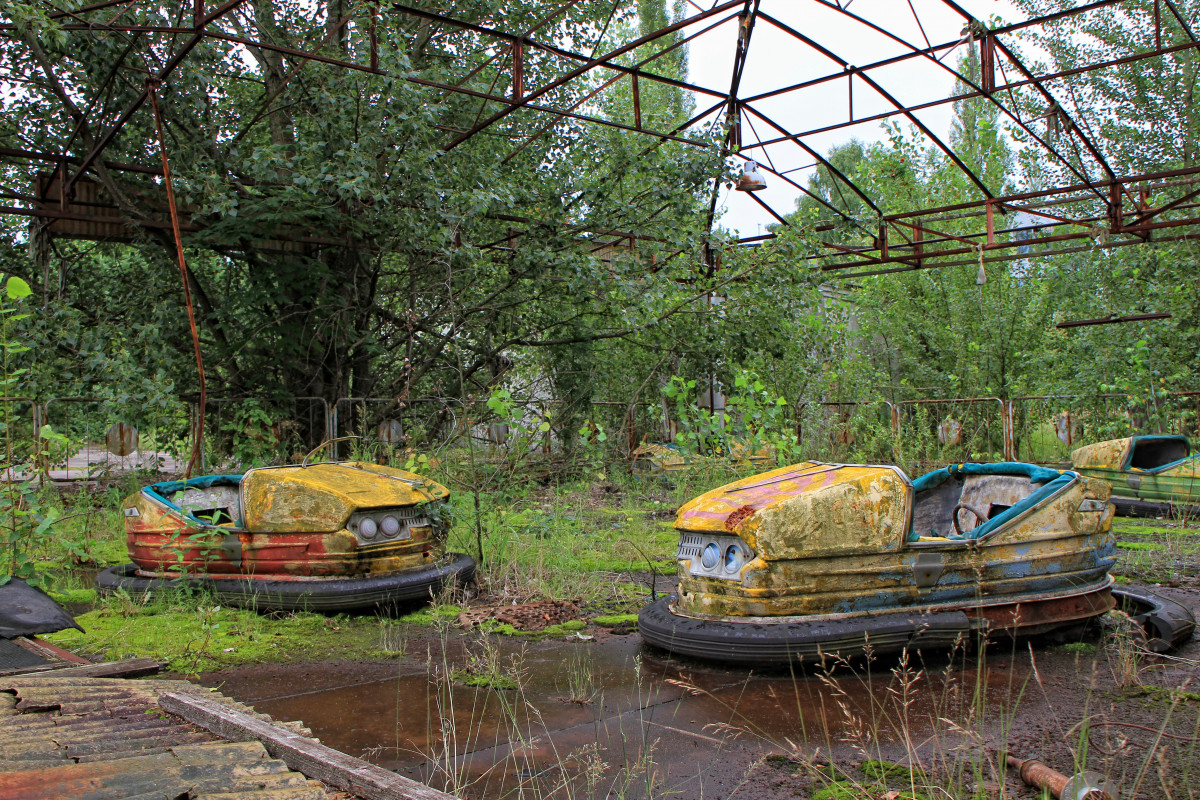
Signs of Soviet decline, amusement park near Chernobyl disaster (occurred 1986).
Photo via PXhere [CC0]


Nowhere ManNowhere Man by Aleksandar Hemon

My rating: 3 of 5 stars


I discovered this novel at a bookshop where I also purchased two other novels written (respectively) by Chinese-American and Cambodian-American women. After reading several international authors, in addition to the classics, I have recently purchased books by authors either translated into English or written by authors with English as a second language. 

This is one of the most recently-written novels I have read, published in 2002. What I find remarkable is that Hemon arrived in the United States in 1991, and began writing in English in 1995, echoing Nabokov (one of my favourite authors). 

The plot encompasses the experiences of Jozef Pronek, a Bosnian stranded in the United States by the war in the former Yugoslavia. (A refugee but not really a refugee.) The character comes from "Blind Jozef Pronek & Dead Souls" in Hemon's first work, a short story collection entitled The Question of Bruno (which I haven't read). 

Different narrators take up the story of Pronek as he moves between an English course, working as a private investigator and a Greenpeace canvasser, with flashbacks between his experiences in Sarajevo and the Ukraine. The different narrators are an interesting device, providing different perspectives of Pronek. 

At times, however, I found this a little confusing, assuming the first narrator was the protagonist who would reappear sometime later in the story. Instead, a seemingly unrelated story of Captain Pick in Shanghai some 100 years earlier echoes the events of Pronek's experiences, culminating in a wonderfully layered finale. 

The subtitle of the novel, The Pronek Fantasies (which I didn't notice until after I had finished the novel), makes a little more sense of the unusual intertwining of plot devices. 

Before I wrote this, I checked reviews of this book from The Guardian and the New York Times

Maya Jaggi (The Guardian) points out the obvious economy of words and the interesting use of the English language. Gary Shteyngart (NYT) points to Pronek's broken English and Hemon's constant references to how everything smells. This I found most interesting. Ernest Hemingway (Death in the Afternoon, 1939, p. 225) was a master in describing the sensual experience. For example:
If qualities have odors the odor of courage to me is the smell of smoked leather or the smell of a frozen road or the smell of the sea when the wind rips the top from a wave...
But Hemon captures the feel of the Soviet Union towards the end, with the train "much too salty" (p. 85), references to the smell of sweat and armpits, and the endless "socialist grease" (p. 94) on everything. 

But my favourite quote captures the imagination and (I imagine) what it was like immediately before the Soviet Union collapsed (p. 85):
I thought that if another revolution were ever to break out in the USSR, it would start on a train or some other public transportation vehicle - the spark would come from two sweaty asses rubbing.
It is true that you can actually smell this novel (more so than any I have read before) and for that alone it is clever. But on finishing the work, I had to sit and wonder. 

Both Jaggi and Shteyngart point to some of the novels shortcomings, and I have other reservations. But I was glued to the chair as I read the work, and elements of the iceberg theory are evident in that as I write I am still asking questions of the characters and the historical story. 

I can imagine the experience of being an immigrant, even though my mono-lingual self would struggle much more than Pronek ever did. 

So what did I get from this work? First, being competent in a language does not a story-teller make. Hemon proves this and I am envious. 

Second, there is something in such works that one cannot get from a classic novel written in a person's first language and culture. This is clear to me, and it is why I am broadening my reading horizons to capture much of the new work that is appearing from authors with immigrant backgrounds and also from international authors only recently being translated into English. 

For poor, mono-cultural me, this is the closest I can get without having to go through the experience myself. 

I think, too, that reading Hemon's first work would be useful, and I will endeavour to buy a copy of Bruno in the near future to test this theory. 

Otherwise, I enjoyed my break from St Theresa and her "vain modesty" trope, but I may need a little more before I can get back to the good saint's crystal castle. Hopefully with less of the olfactory saltiness of Prenok's past to haunt my nostrils.


© 2025 Dr Michael de Percy
made with by templateszoo