The Critic as Philosopher: Ruskin's Polemic for the Common Man

Let Us Beat Swords into Plowshares by Yevgeny Vuchetich, donated to the United Nations by the Soviet Union in 1959. Photo taken by Pharos from UN grounds showing sculpture in front of the East River, CC BY-SA 3.0 via Wikimedia.


On Art and LifeOn Art and Life by John Ruskin

My rating: 5 of 5 stars


This book consists of two sections, "The Nature of Gothic" from Vol. 2 of The Stones of Venice (1853), and "The Work of Iron", originally given as a lecture at Tunbridge Wells, and later published in The Two Paths (1859). I learnt of the importance of Ruskin's influence only recently when watching the movie Mr Turner (2014), starring one of my favourite actors, Timothy Spall, in the lead role. Ruskin was a supporter of the work of J.M.W. Turner and apparently played a role in elevating landscape painting as a major genre. I enjoy Turner's work immensely, and this encouraged me to read some of Ruskin's work. I have not been disappointed and I have discovered other works that I intend to read, which coincide with a particular publisher's series. I find the Dover Thrift Editions of great works easy to read in terms of size of print and page, and Dover also has a series on architecture (I have read the work of Le Corbusier from this series). Ruskin's The Seven Lamps of Architecture is presented in the Dover series, so this will be a welcome addition to my library. I find architecture fascinating, and while I recently designed and built my own chook pen, I stand in awe of the great architectural and engineering miracles we use every day, often without giving a thought for the magnificence of the outcome of thought and practice. There is something about architecture that stirs the soul. I am reminded of Lord Kenneth Clark's 1960s book and BBC TV series, Civilisation, where Clark tells the audience that his personal view of the history of civilisation focuses on art and architecture, and he does not care whether others should think him a fuddy-duddy or not. I went off in search of the precise words, and was struck that Clark's first words are Ruskin's! "Ruskin said":
Great nations write their autobiographies in three manuscripts—the book of their deeds, the book of their words, and the book of their art. Not one of these books can be understood unless we read the two others; but of the three, the only quite trustworthy one is the last.
The introductory episode is available on YouTube at the moment:


However, in this book, Ruskin first focuses on the nature of Gothic architecture, and presents an interesting view of workmanship and the worker: if one wants a consistent product, much like a machine would produce, then the man becomes a tool - if one wants a creative man, then the outcome will be inconsistent, but of a finer nature. As the subtitle reads:
You must either make a tool of the creature, or a man of him. You cannot make both.
Ruskin uses the example of Venetian glass and its artisanal qualities compared with the precisely uniform production glass of his time. I am pleased to learn that my own thoughts on the standardisation of education echo Ruskin's. Ruskin's idea of truth is:
...that great art, whether expressing itself in words, colours, or stones, does not say the same thing over and over again... Yet... this is... only hidden from us... by false teaching. Nothing is a great work of art, for the production of which rules or models can be given.
I have the same argument against marking rubrics for essays - if it were possible to produce a perfect marking rubric, there would be no need to teach essay writing; yet marking rubrics are somehow seen as "fairer"! More likely, as Lord Kenneth Clark said, the ancient civilisations ended because they were "exhausted". And the next time I hear someone mention coining a phrase like "change fatigue", my scepticism will know no bounds! Ruskin (p. 36) basically outlines all we need to know about change, and more eloquently than any recent airport-read management guru book. The trouble with reading classic texts is one realises how much written today is a rip-off of the past, but presents itself as something new, without a hint of an acknowledgement. And this is not because it is plagiarised, but that the contemporary author has simply not done her or his homework, and has independently thought up something that had already been thought before. Imagine how much further we might advance if we did not have to reinvent the wheel every time we began to apply our thought-forces to a problem? Hence the literature review. But what if one could be original. Being original is more difficult than one might think. In the second section of the book, Ruskin discusses the importance of iron in its many forms. Here I learn more about geography, and the chalybeate spring (a natural mineral spring containing iron salts) at Tunbridge Wells, and the importance of this site to so many great artists. Ruskin was addressing a general audience and arriving at turning "swords into ploughshares" (Isaiah 2:4) from a mineral spring is a fascinating journey that is captivating, if a little bewildering, as if caught up in some 1960s psychological experiment. There are several messages in this book. But most prominent is the belief that forcing labourers to work as machines, in order to reduce the price of goods, is STEALING (capitalised in the original) from the workers. (Ruskin believed that "the architect [should] work in the mason's yard with his men", p. 25) Moreover, love of order (or the standardisation aesthetic, as I would call it) is useful in "practical matters":
...but love of order has no more to do with our right enjoyment of architecture or painting, than love of punctuality with the appreciation of an opera.
I daresay that Ruskin, if he were writing today, would be regarded as "discursive". But I like his style. There is so much that underpins his work, a depth of reading that is obvious, yet creates the scaffolding for his originality; political, yet not radical; radical, yet not revolutionary; revolutionary, yet not wanting to overthrow the status quo; accepting of change, or more importantly for my own thinking, of the punctuated equilibrium of living and civilisation, but all moving toward an end where men (sic) no longer wage war, having learnt to live peacefully (much like the literal truth-speaking "long-livers" in George Bernard Shaw's Back to Methuselah). I must admit that the portrayal of John Ruskin in Mr Turner corrupted my imagination, and I pictured a lisping flatterer who was socially-tolerated, yet privately thought a fop. But now having read Ruskin "in the flesh", I am inspired, and, in addition to finding another guide to so many things I enjoy (landscape painting, Clark's Civilisation, Turner's art, etc), I have developed a new appreciation for the role of the critic.
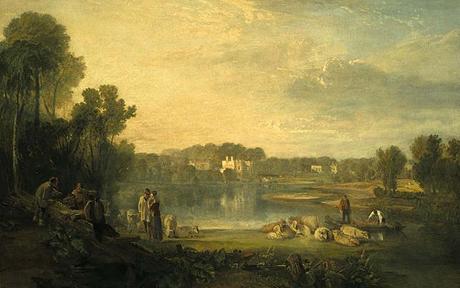




On Criticism: Pope. Spawn of the Glorious Revolution

Pope's Villa at Twickenham by J.M.W. Turner (1808)
Public Domain via Wikimedia.


An Essay on CriticismAn Essay on Criticism by Alexander Pope

My rating: 5 of 5 stars


There are a number of famous phrases in this essay:
To err is human; to forgive, divine.
A little learning is a dang'rous thing.
For fools rush in where angels fear to tread.
And I learnt a new word: "coxcomb" - an archaic term for a dandy. Pope draws on numerous place names as synonyms for The Ancients, so Aristotle is "the Stagirite"; Virgil is "the Mantuan Muse"; and,
To copy nature is to copy them.
After reading a few articles by and about Harold Bloom, having almost finished John Ruskin's On Art and Life, and having made a start on Oscar Wilde's The Critic as Artist, I have gained an appreciation for the work of the critic. Pope points out that Aristotle was a critic of Homer, and Maevius, known for his criticism of better writers (and of Augustus Caesar's vintage), was well-critiqued by both Virgil and Horace. Pope provides advice for the genius, too:
Launch not beyond your depth, but be discreet, And mark that point where sense and dulness meet.
and
One science only will one genius fit; So vast is art, so narrow human wit.
Our talent requires constant effort, and spreading ourselves too thin means:
Like kings we lose the conquests gain'd before.
Reading is important (especially to "know well" the Ancients), and we should:
Read them by day, and meditate by night.
I could feel Mortimer Adler lurking in the background, and a return to How to Read a Book revealed Pope's sentiments (p. 11):
There have always been literate ignoramuses who have read too widely and not well.
As Pope said:
The bookful blockhead, ignorantly read, With loads of learned lumber in his head.
But Pope also touches on the problem for converting sound reading into writing (which is increasingly my problem):
That on weak wings, from far, pursues your flights; Glows while he reads, but trembles as he writes.
Adler spoke of "coming to terms with the author", and Pope seems to be Adler's inspiration:
A perfect judge will read each work of wit With the same spirit that its author writ
Yet Pope draws on the folk tradition, too, especially in relation to the "father" of all sins, pride, "the never-failing vice of fools"; and Socrates' notion of the more we know, the more we know we don't know much ("New, distant scenes of endless science rise!"). In effect, Pope argues that pride prevents reason. If pride can be driven away, then we can use feedback from friend and foe alike to correct our faults. The Stoics, too, can be seen in the background, with echoes of Epictetus' (Discourses 3.24.17) warning that happiness and yearning for something one doesn't have are incompatible, in effect, perfectionism is desiring the impossible, reflected in:
Whoever thinks a faultless piece to see, Thinks what ne'er was, nor is, nor e'er shall be.
Nietzsche gets a guernsey, too, or, should I say that Nietzsche draws on Pope's Dionysian-ness ("Dennis of the Grecian stage"). There is so much in this essay that a second and third reading will be rewarding. And not just for lessons in literature and history - geography, too. As it turns out, London's Duck Lane (not the current Duck Lane, which Google Maps shows is an alley), now known as "Little Britain", was in Pope's time an area for second-hand booksellers, and before that an area for publishers, too. There is so much in Pope that is familiar, much like John Stuart Mill's On Liberty (which is like reading my own mind, the content is basically the liberal arts curriculum of a modern education). But the difference is that Pope's work requires a more thorough reading of the Great Books. While I have much more to learn about the classics, it is clear that the more familiar one is with them, then the more rewarding a reading of Pope will be.

And what about the Glorious Revolution? The Westminster political system begins with the end of the old regime in 1688, thanks to William of Orange. Alexander Pope was born in 1688. So there you go.


Beyond Good and Evil: or, Breathing is a Virtue

Quatre danseuses et Nijinski (Four Dancers and Nijinsky) by Adolf de Meyer, circa 1914.
Public domain via Wikimedia.


Beyond Good and Evil: Prelude to a Philosophy of the FutureBeyond Good and Evil: Prelude to a Philosophy of the Future by Friedrich Nietzsche

My rating: 4 of 5 stars


The other evening, a few pages from the end of this work, I fell asleep listening to Alan Watts lecturing on virtues. I find it difficult to articulate the connection to Nietzsche, but what I comprehended as I awoke, while being in a state not dissimilar to that of Debussy's faun, was this rough recollection:
You cannot be virtuous. If you become virtuous and you are aware of being virtuous, then you are prideful and thus no longer virtuous. Virtues are not self-conscious, and you cannot consciously be virtuous. Breathing is a virtue. You don't think about it, you are not responsible for it, it happens 'un-self-consciously'. That is virtue.
I understand that Alan Watts was discussing elements of Eastern philosophy, but Nietzsche mentions Eastern philosophy numerous times. Following Mortimer Adler's guidance in How to Read a Book, I now take notes in pencil in the margins of my books. This rather short book is full of notations; Latin, French, Greek, German, and Italian words and phrases; class consciousness, waiting too long to display one's genius, "the herd"; the Will to Power; morality; and so on. Too much to summarise here appropriately. But I read in Nietzsche a critique of mediocrity, and it provides me with an awakening to the class-based cringe that has been highlighted by my reading and study over the years. Alan Watts said something like being self-conscious won't help one to be virtuous. Benjamin Franklin wrote that although he worked to consciously improve himself, using his 13-week virtues checklist, he was aware that he could never be perfect. If I take into account Nietzsche's critique of the herd morality and religion, and the privilege of rank and the position adopted by others in relation to my lowly class-based existence (which doesn't manifest itself in any meaningful way outside my own head), then the idea of "beyond good and evil" makes some intuitive sense. Nonetheless, I am far from articulating Nietzsche's ideas beyond what I can grasp from a handful of his work. I may take some solace in that Franklin couldn't be virtuous, that Adler tells me there is nothing wrong with interpreting my reading without the aid of others, that Nietzsche writes much like La Rochefoucauld, and that he thought the Stoics were wrong. This is interesting because the Stoics advocated "living according to one's nature". As it is so natural, then how can one "will" oneself to live in a way that is predestined? This is one of the most helpful explanations of the deductive method! On flicking back through my notes, two things are noticeable. First, the race elements the Nazis picked up on (thanks to Nietzsche's sister, I believe). This is no worse than Jack London, writing not that long after Nietzsche and I encountered parts that wouldn't fit with Nazism. Second, the attitude towards women. This was written before universal suffrage, but clearly, Nietzsche was no John Stuart Mill. Indeed, Nietzsche was a critic of utilitarianism. I will finish with this quote on scholars and artists (I had heavily underlined it while reading - there is always a pencil on hand these days), one that brings together in Nietzsche's words what I felt in my "faunish" moment while listening to Alan Watts (pp. 142-3):
One finds nowadays among artists and scholars plenty of those who betray by their works that a profound longing for nobleness impels them; but this very need of nobleness is radically different from the needs of the noble soul itself, and is in fact the eloquent and dangerous sign of the lack thereof. It is not the works, but the belief which is here decisive and determines the order of rank - to employ once more an old religious formula with a new and deeper meaning - it is some fundamental certainty which a noble soul has about itself, something which is not to be sought, is not to be found, and perhaps, also, is not to be lost. -The noble soul has reverence for itself.
It would seem that it is "beyond good and evil".


© 2025 Dr Michael de Percy
made with by templateszoo